 TESTYOUR
[Column] Why Did Gon Transform into 'Adult Gon'? The Trauma of Kite and the Terrifying Truth of Pure Innocence
"I don't care anymore... It doesn't matter if this is the end. So give me... everything..."
Deconstructing the most shocking, self-destructive protagonist awakening in manga history.
In the pantheon of shonen battle manga, a protagonist's ultimate power-up is typically designed to evoke triumphant catharsis. When Goku ascends into a Super Saiyan upon Krillin's demise in Dragon Ball, the audience cheers for the vindication of righteous justice.
Yet, in the climactic chapters of the Chimera Ant arc in Yoshihiro Togashi's Hunter x Hunter, when Gon Freecss forcibly accelerates his body into a horrifying monolith of muscle to crush Neferpitou, the reader experiences no such ecstasy. Instead, one is paralyzed by pure dread, tragic heartbreak, and macabre disgust.
Known among fans as 'Adult Gon' (or 'Gon-san'), this grotesque metamorphosis was not a heroic milestone; it was a soul-rending act of spiritual suicide. Why did Gon burn his entire lifespan, god-tier potential, and sanity on a sacrificial pyre? What was the psychological weight of Kite, and what does this catastrophe reveal about the monstrous nature of unbridled innocence?
Thank goodness... I am the one he is going to kill, and not the King..."
1. What Kite Truly Meant to Gon: The Surrogate Father and the Foundation of Self
To understand Gon's descent, one must first recognize that Kite was not merely a respected mentor or an expedition comrade. In Gon's fractured psyche, Kite was the bedrock of his entire existence.
First, Kite was the genesis of Gon's identity as a Hunter. When Gon was an isolated child on Whale Island, nearly slaughtered by a Foxbear, Kite intervened and struck him for his foolish recklessness. It was Kite who revealed to the boy that his father, Ging Freecss, was not dead, but one of the world's greatest Hunters. Gon's very motivation to cross the seas and conquer the Hunter Exam originated from Kite's revelation.
Second, Kite was the physical surrogate for an absent father. To Gon, Ging was an elusive ghost—an unreachable mythological figure. Kite, however, was Ging's direct pupil, trained by him and validated by him. Traveling alongside Kite provided Gon with tangible validation: walking Kite's path meant touching the living world of his father.
Kite's Threefold Significance in Gon's Mind
1. Origin of Identity: Saved his life and inspired him to become a Hunter.
2. Surrogate Father: Ging's only visible representative and a tangible anchor of belonging.
3. Crippling Survivor's Guilt: The conviction that Kite died purely because Gon was too weak and arrogant to heed warnings.
2. The Severed Arm vs. The Decapitation: The Explosion of Festering Self-Hatred
To genuinely dissect Gon's psychological breakdown, one must separate the trauma into two distinct stages: when Kite lost his arm, and when Kite was decapitated.
Stage 1: The Severed Arm — The Inception of Toxic Self-Hatred and Paralyzing Anxiety
En route to the Chimera Ant nest, Kite sensed Neferpitou's horrifying En and screamed at Gon and Killua to retreat. Paralyzed by raw terror, Gon froze. In that microscopic fraction of a second, Kite threw himself forward to shield the boys, sacrificing his right arm to Pitou's sudden strike. Had Killua not knocked Gon out cold and sprinted away, both boys would have died instantly.
When Gon regained consciousness, the first emotion that took root in his mind was not anger at the enemy, but consuming self-hatred:
"Because I was weak, because I froze like a fool, Kite lost his arm."
From this precise moment, a venomous sense of survivor's guilt began poisoning Gon's psyche. But an immature child cannot mentally sustain such catastrophic self-loathing. Thus, Gon engaged a desperate psychological shield: "Kite is invincible; he must still be alive. We just have to train and save him!" He buried his terrifying anxiety beneath manic urgency and stubborn delusion.
Stage 2: The Decapitation and Corpse Puppet — Total Denial Cracking into Apocalyptic Explosion
The horrific reality, however, was already sealed: Kite's severed head had been resting in Pitou's lap for weeks, and his reanimated, lobotomized corpse was being utilized as an automated punching bag.
Any rational mind would have accepted death. But Gon doubled down on his infantile defense mechanism:
We just have to beat Pitou, grab them by the collar, and force them to fix him!"
This was not optimism; it was the frantic clawing of a child who knew that the moment he accepted Kite was dead, the truth that 'I murdered Kite' would obliterate his soul.
As this unacknowledged anxiety rotted within him, Gon turned venomous toward his dearest friend, spitting chilling cruelty at Killua:
"Must be nice, Killua. Being so calm... since you have nothing to do with this."
And finally, in Peijin, when Pitou bluntly declared: "I'm sorry... that man was already dead. My Nen cannot restore a corpse"—
The immense self-hatred and survivor's guilt that had been festering ever since Kite's arm was severed detonated like a nuclear warhead. With the illusion shattered, Gon's soul chose immediate, total bankruptcy.
3. Togashi's Deconstruction: Gon is a Blank Slate of Frightening Amoral Innocence
Yoshihiro Togashi never designed Gon Freecss to be a conventional hero of justice. As the antique appraiser Zepile astutely observed during the Yorknew City arc:
It's a terrifying, pure madness. I don't know whether to admire him or fear him."
Gon's moral barometer is entirely dictated by egocentric tribalism (Are you in my circle, or not?) rather than universal ethics:
- Rage at the Troupe vs. Acceptance of Killua: In Yorknew City, Gon wept with fury at the Phantom Troupe, demanding: "How can you slaughter innocent people who have nothing to do with you?!" Yet when befriending Killua, who was raised as an assassin with a trail of corpses behind him, Gon brushed it off completely: "Killua is my friend!" Universal morality meant nothing; only whether someone harmed 'his people' triggered his switch.
- Unsettling Indifference to Genthru: After Genthru butchered dozens with explosives in Greed Island, Gon used Angel's Breath to casually heal Genthru's blown limbs once the match was over and his friends were safe. To Gon, Genthru was not a monster—merely an opponent playing by game rules.
The Chilling Role Reversal: A Weeping Monster vs. A Vengeful Demon
This moral contradiction reached its artistic climax during the palace invasion, where Gon finally confronted Neferpitou.
Inside the palace room, Neferpitou was not tearing flesh; the Royal Guard was kneeling on the floor, weeping with profound compassion, desperate to save the life of Komugi—a blind, fragile human girl. A predatory Chimera Ant was demonstrating transcendent empathy and humanity.
In contrast, what did Gon look like? With dead, blackened eyes and veins bulging with murderous rage, Gon cared nothing for Komugi's life. When Killua attempted to intervene, Gon treated him as a traitor and explicitly threatened to murder the helpless blind girl if Pitou did not cease treatment immediately.
Who was the monster, and who was human? Togashi stripped away the romance of childhood innocence to reveal its darkest face: unadulterated innocence without wisdom or empathy is indistinguishable from demonic psychopathy.
| Metric | Neferpitou (Chimera Ant) | Gon Freecss (Human Protagonist) |
|---|---|---|
| Psychological Motivation | Selfless devotion to save a human girl (Komugi) at the King's behest | Obsessive, vengeful desire to avenge Kite and escape guilt |
| Demeanor in Confrontation | Vulnerable, bowing low, begging for mercy and time | Wrathful, remorseless, willing to execute an innocent hostage |
| Thematic Trajectory | A beast learning human warmth and empathy | A human child descending into feral monstrosity |
4. "He's Already Dead": The Final Shattering and the Suicide Pact of Nen
When Pitou finished stabilizing Komugi and escorted Gon to Peijin, the creature delivered the inescapable truth:
"I'm sorry. I didn't mean to lie to you... but that man was already dead. My Nen cannot restore a soul."
In that single sentence, Gon's manufactured universe evaporated. The defense mechanism failed. The unbearable reality that Kite had been rotting for weeks and would never return because of Gon's failure crashed into his psyche like an avalanche.
Unable to tolerate living in a reality stained with this irredeemable guilt, Gon chose total spiritual bankruptcy:
So give me... everything..."
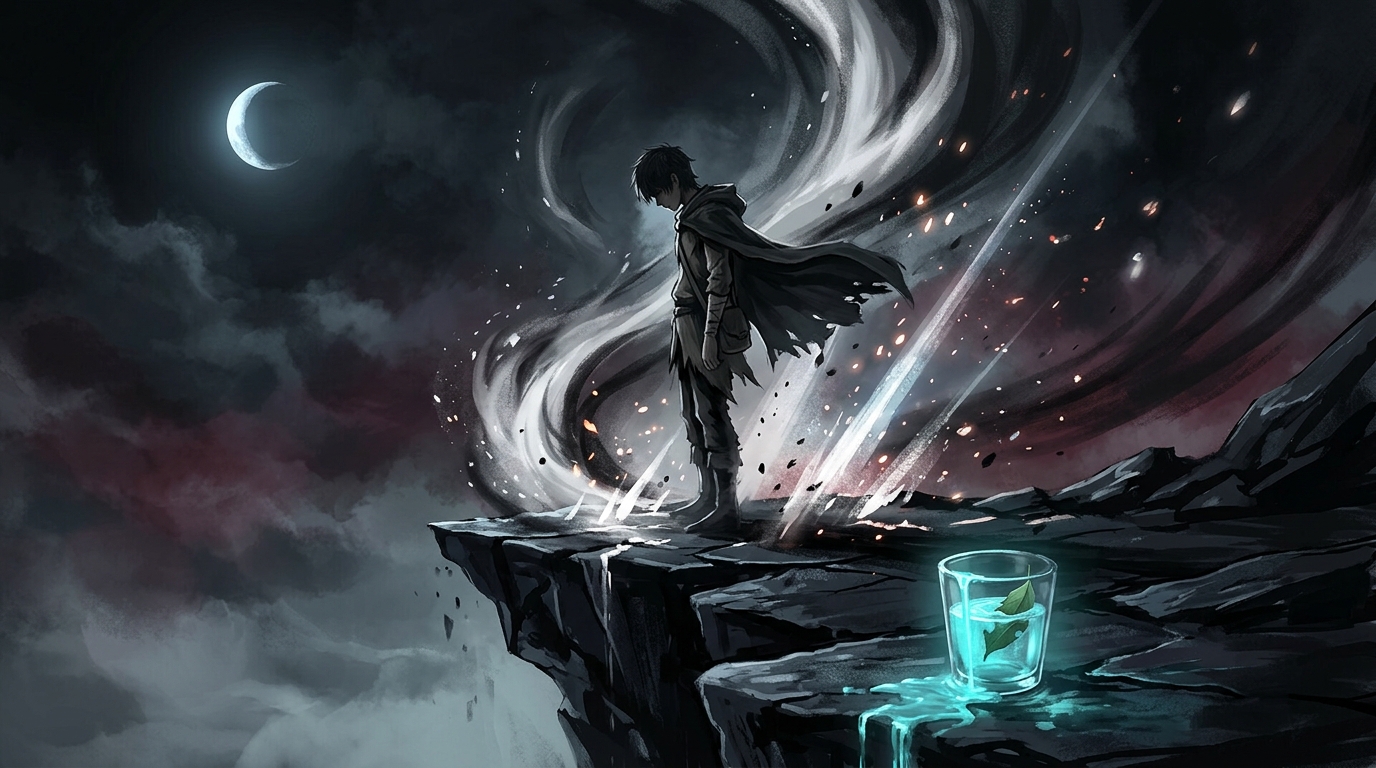
(Original TESTYOUR illustration)
In the physics of Nen, Vows and Limitations (Restriction and Pledge) multiply power proportionally to the severity of the sacrifice.
As an Enhancer, Gon's absolute stubbornness fused with suicidal despair to enact the ultimate transaction:
- The Sacrifice: His entire natural lifespan, the decades of training needed to reach his theoretical biological peak, and the permanent revocation of his ability to ever use Nen again.
- The Output: A monstrous, mature physical vessel possessing an aura reservoir capable of vaporizing a Royal Guard in minutes.
'Adult Gon' was never a victory form. It was a thermonuclear suicide bomb disguised as an awakening—a child choosing complete annihilation simply to drag his tormentor into the grave.
The Secret of Water Divination: Why Only the "Overflowing Simplicity" of an Enhancer Could Produce Adult Gon
Here, one must recall the most primal method of aura classification in the Hunter universe: the 'Water Divination (水見式)' test, and Hisoka's aura personality theory.
In Water Divination, where a practitioner focuses their Ren into a cup of water with a floating leaf, the reaction of an Enhancer is singular: the volume of water overflows. Unlike Transmuters who alter taste, Conjurers who spawn impurities, or Manipulators who move the leaf, Enhancers simply cause raw, unadulterated aura to rupture the physical limits of the vessel.
According to Hisoka's personality analysis, Enhancers are defined by one trait: "Simple and single-minded (単純で一途)."
They cannot lie, their emotions are completely transparent, and once set on a trajectory, they possess zero internal brakes. It was precisely this radical, unyielding simplicity that made Adult Gon possible:
- Had Gon been a Manipulator or Conjurer: Analytical, calculating minds could never enact such a contract. Thoughts like "If I die here, how will I ever meet my father?" or "This is an inefficient trade; I must retreat and formulate a new contingency" would immediately infect the mind. The moment calculation and self-preservation enter, the absolute purity of the Vow dissolves.
- Had Gon been a Transmuter: Like Killua, fickle and adaptable, he would have recognized the harsh absurdity of the situation and compromised, seeking an indirect detour.
- As an Enhancer: Gon had no Plan B. No hedge. No concept of sunk cost. There was only one singular equation: "Kill Pitou for Kite. My life, my Nen, my future—none of it matters."
To make matters more volatile, Gon possessed a pathological disregard for his own physical survival. As demonstrated against Hanzo and Genthru, Gon was already a boy who routinely permitted his limbs to be fractured or blown apart without flinching if it secured his objective.
When this uncalculating simplicity merged with his ingrained habit of self-mutilation and suicidal grief, the result was a catastrophic transaction: signing a blank check sacrificing decades of biological life and god-tier Nen without a microsecond of hesitation.
Uvogin and Palm: The Terrifying Shared Trait of Enhancers
This uncompromising simplicity and blinding obsession is not a singular aberration in Gon. If we examine other prominent Enhancers created by Yoshihiro Togashi—namely Phantom Troupe's Uvogin and Palm Siberia—the psychological blueprint shared across all Enhancers becomes shockingly clear.
- Uvogin's Defiant Demise (Zero Calculation in the Face of Death):
When bound by Chain Jail with Judgment Chain wrapped around his heart, Uvogin knew full well that Kurapika, an avenging survivor of the Kurta massacre, would likely execute him regardless of his answers. Yet a calculating trickster (a Manipulator or Transmuter) would have fed false intelligence, stalled for time, or waited for an opening.
Uvogin had no such cunning. Refusing even the facade of selling out his brethren, he roared without hesitation: "Kill me, you idiot!" Like Gon, Uvogin extinguished all self-preservation instincts when loyalty was on the line, proving the terrifying single-mindedness of the Enhancer archetype. - Palm Siberia (Obsession Overriding Sanity and Brainwashing):
Palm embodies the terrifying extreme of Hisoka's "single-minded earnestness." When fixated on someone (Knov, and later Gon), her emotional drive erupts into near-psychotic, knife-wielding devotion. Even after being captured and biologically mutated into an emotionless Chimera Ant soldier, neither outside rescue nor logic broke her cognitive brainwashing—it was her pure, monolithic Enhancer drive to protect Gon that shattered the Queen's control from within. Her ability, 'Black Widow,' directly converts her emotional conviction into an impenetrable armor of reinforced hair.
Uvogin's suicidal defiance, Palm's obsessive hysteria, and Gon's monstrous transformation all share the identical psychological foundation: the moment an Enhancer locks onto a single conviction, all self-preservation, tactical doubt, and future considerations are instantly vaporized, leaving behind an unstoppable, self-immolating battering ram.
How Would Your Cup of Water React?
Are you a pure, unstoppable Enhancer whose energy overflows without compromise, or a tactical Manipulator who orchestrates from behind the scenes? Discover your natural Nen affinity and cognitive type.
Take the Water Divination Nen Test →
5. The Inversion: From Darkness to Light, and Light to Void
The enduring tragedy of Hunter x Hunter lies in the dual character arcs of Gon and Killua.
Killua was born into the assassin underworld, groomed to be an unfeeling executioner. When he met Gon, he marveled at the boy's radiance, whispering: "Gon, you are light. Sometimes you shine so brightly that I have to look away..."
Yet by the arc's conclusion, their destinies had tragically swapped:
- Killua: Transcended his conditioning, removed Illumi's needle, learned love and compassion, and stepped out from the dark into warm human light.
- Gon: Allowed his blinding light to scorch everything around him, imploding into a pitch-black abyss of self-destruction.
Killua's desperate weeping as he held Gon's charred, mummified remains was not grief over a battle lost; it was the agony of watching his savior willingly transform into a demon and destroy himself.
Epilogue: What Lies Ahead for Gon? A Sobering Lesson and a Necessary Comma
Through Alluka Zoldyck's reality-warping miracle, Gon was pulled back from the brink of physical mummification. But the invoice for his awakening was sobering.
When Gon finally reached the summit of the World Tree and sat face-to-face with his long-sought father, Ging Freecss, he panicked upon realizing he could no longer perceive or manipulate his own Nen aura. Ging's response provided a crucial insight:
You gambled your life, threw everything away, and somehow survived intact. Asking for anything more would incur divine punishment.
Go figure out what you want to do with your life now."
Of course, Gon is the titular protagonist of Hunter x Hunter—there is little chance his journey is permanently over. As Ging noted, his aura didn't evaporate into nothingness; his physical aura nodes simply closed back up to a baseline human state. When Gon eventually discovers what he genuinely wants to pursue in life, the door remains wide open for him to reawaken his Nen in a new, mature form (after all, Togashi explicitly foretold an eventual fated encounter between Gon and Gyro!).
Yet Togashi's decision to have Gon sit out the Dark Continent expedition is profoundly grounded. In an ordinary battle manga, the resurrected hero would instantly gain a power-up and march toward the next grand battlefield. Togashi upheld the cold reality that even a chosen protagonist doesn't get a free pass after pledging his entire future on a suicide pact.
Returning to Whale Island to catch up on missed middle school homework under Aunt Mito's roof might not look glamorous for a shonen protagonist, but it is a much-needed breather after paying such a brutal price.
Raw passion can be inspiring when guided well, but when driven by blind emotion, it easily turns into a reckless fire that burns down everything in its path.